The best SSD for NAS use is a NAS-rated drive with enough endurance for the workload. As of October 2026, the one I’d start with for most people is the Sandisk NAS 600 SATA SSD. If your NAS has M.2 slots, I’d look at the Sandisk NAS 800 NVMe SSD. The exception is Synology, which only supports its own M.2 SSDs for a storage pool (and requires them for cache on 2025 or later models), so that’s the Synology SNV5420 NVMe SSD.
With that said, I would not put SSDs in every NAS. For most bulk storage, I’d still buy hard drives.
Disclosure: Some links below are Amazon affiliate links, which means that I earn a percentage of each sale at no cost to you. Thank you for your support.
Best SSD for NAS: My Quick Picks
If I were buying SSDs for a NAS today, this is how I’d break it down. The best NAS SSD for most people is the Sandisk NAS 600, and the best SSD for NAS storage on M.2 slots is the Sandisk NAS 800.
| SSD | Format | Comes in | Endurance | Buy it for |
|---|---|---|---|---|
| Sandisk NAS 600 SATA SSD | 2.5-inch SATA | 500GB to 4TB | 600 TBW at 1TB | Most SATA bays |
| WD Red SA500 M.2 2280 SATA SSD | M.2 2280 SATA | 500GB to 2TB | 600 TBW at 1TB | SATA-only M.2 slots |
| Sandisk NAS 800 NVMe SSD | M.2 2280 NVMe | 960GB to 7.68TB | 1,750 TBW at 960GB | NVMe pools, larger cache |
| WD Red SN700 NVMe SSD | M.2 2280 NVMe | 250GB to 4TB | 1,000 TBW at 500GB | Small cache drives |
| Synology SNV5420 NVMe SSD | M.2 2280 NVMe | 400GB to 1.6TB | Over 700 TBW at 400GB | Synology M.2 pools, and M.2 cache on 2025 and later models |
| Synology SAT5221 SATA SSD | 2.5-inch SATA | 480GB to 3.84TB | Over 1,700 TBW at 960GB | Synology models requiring listed drives |
Synology rates its drives on an enterprise workload, so its endurance numbers aren’t directly comparable to the others.
Seagate no longer lists the IronWolf 125 (the old first pick on this page), and it was not sold new on Amazon when this was updated in October 2026.
When an SSD for NAS Storage Makes Sense
I’d use an SSD for NAS storage when the workload actually benefits from it. That means virtual machines, Docker containers, databases, active project files, or a NAS where noise matters. When I tested a RAID 1 NVMe volume against a two-drive SHR hard drive array on a Synology NAS in 2024, a Home Assistant VM went from booting in 2 minutes and 35 seconds to 41 seconds. That’s about as extreme of a scenario as you can get, though.
An all-flash NAS is where you see that the NAS decides how fast your SSDs are. When I tested the TerraMaster F8 SSD Plus in 2024, I loaded it up with eight 250GB WD Red SN700 NVMe SSDs that Western Digital provided. Every NVMe slot in that NAS is capped at PCIe Gen 3 x1, which is roughly 1GB per second per drive. In RAID, that still maxes out the 10GbE connection, but it also means each drive only gets one of the four PCIe lanes it was built for.
When I Would Not Use SSDs in a NAS
I would not use SSDs just because they’re faster on paper. A 1GbE connection tops out around 125 MB/s, so the network becomes the bottleneck before the drives do. I’d also avoid them if the main goal is storing media, backups, surveillance footage, or archives, as you get far more capacity for the money with hard drives, and my guide on the best hard drives for NAS devices covers those.
Why NAS SSDs Are Different
The reason I wouldn’t throw any random consumer SSD into a NAS is endurance. A NAS is normally powered on 24/7, and the drives can see a lot more sustained writes than a desktop SSD. The endurance rating (TBW, or terabytes written) is the spec I look at first. It’s generally what the warranty goes off of as well, and the Sandisk NAS drives below are covered for five years or until they reach their TBW limit.
With that said, on the SATA side the TBW is about the same as a good consumer SSD’s, so what you’re getting is a drive designed for continuous 24/7 use in multi-drive and RAID setups.
Best SATA SSD for NAS
When I think of a NAS where speed is important, I think of regular old 2.5-inch SSDs that connect through SATA. They go in the same bays as your hard drives (confirm that your trays support 2.5-inch drives), and they’re all about the same from a top-speed perspective. The best SATA SSD for NAS use is one built to run 24/7, and today that’s the Sandisk NAS 600.

Sandisk NAS 600 SATA SSD: Best SATA SSD for Most People
500GB · 1TB · 2TB · 4TB · 5-year warranty
This is Sandisk’s current NAS SATA drive and the new generation of the WD Red SA500, with the same TBW ratings at every capacity (350 TBW at 500GB up to 2,500 TBW at 4TB). The one thing to know is that its data sheet lists TLC NAND but no DRAM, though Sandisk still says it’s designed for continuous operation in 24/7 NAS environments. It was only announced in August 2026, and I’m going off the data sheet here, but it’s the SATA drive I’d buy today.
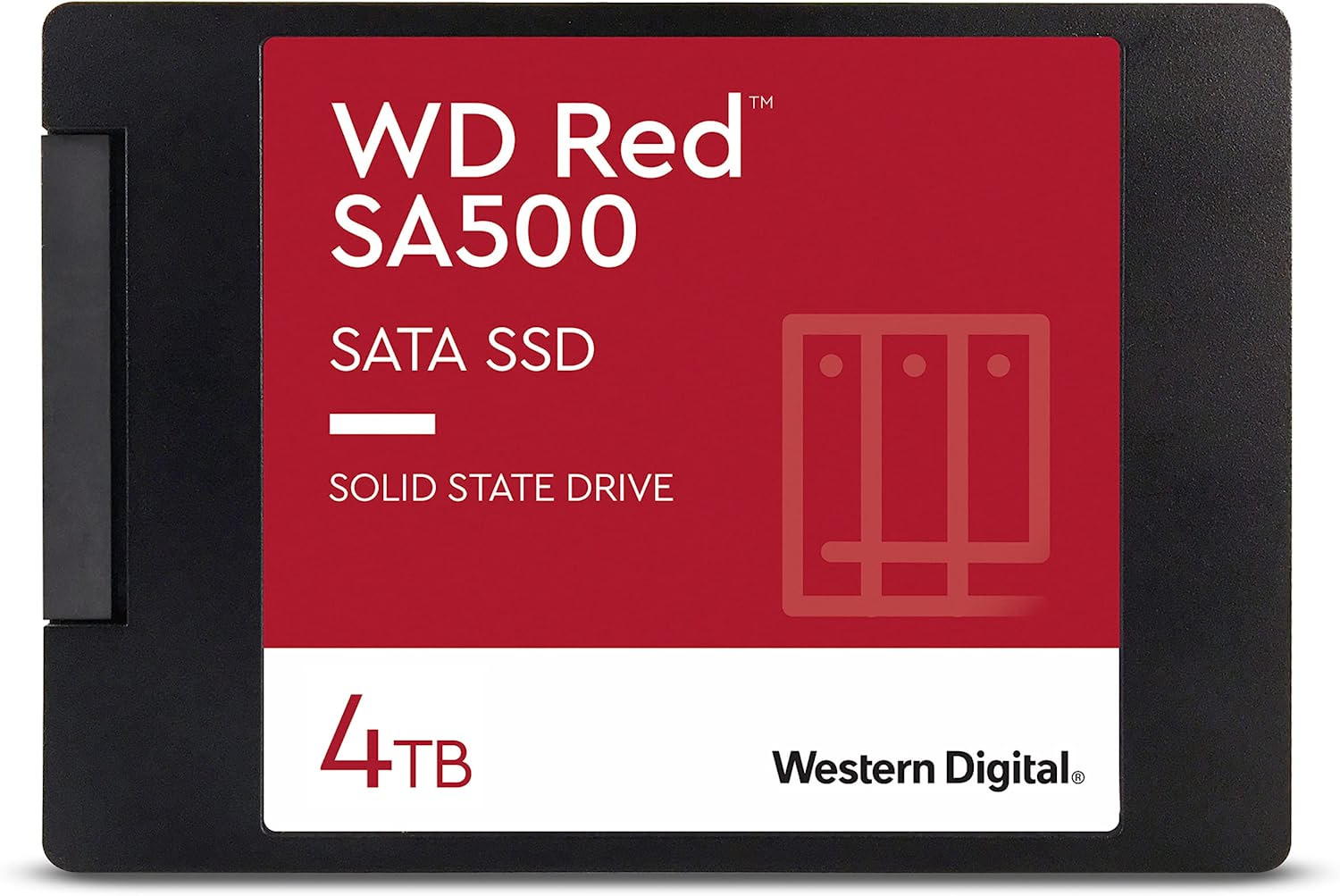
WD Red SA500: Best for M.2 SATA Slots
M.2: 500GB · 1TB · 2TB · 2.5-inch 4TB · 5-year warranty
The WD Red SA500 is the previous generation, but Sandisk still lists it. The main reason to buy it over the NAS 600 is that it comes in an M.2 2280 SATA version. It also comes in a 2.5-inch 4TB with the same 2,500 TBW rating as the 4TB NAS 600.
Best NVMe SSD for NAS
The best NVMe SSD for NAS use is the Sandisk NAS 800 at 960GB and up, and the WD Red SN700 below that. Not every NAS officially supports NVMe storage pools, though (Synology only does with its own M.2 SSDs, covered below).

Sandisk NAS 800 NVMe SSD: Best NVMe SSD for Most People
960GB · 1.92TB · 3.84TB · 7.68TB · 5-year warranty
This is Sandisk’s new generation of the WD Red SN700. It’s PCIe 5.0, but it runs at whatever speed your NAS gives the slot, so do not buy it for the headline speed. Endurance is 1,750 TBW at 960GB, which is a little lower than the 1TB SN700 (2,000 TBW), but it’s higher at 1.92TB and 3.84TB. I have not used it, but for 960GB and up, it’s the NVMe drive I’d buy today. It’s the current generation, and it’s the less expensive of the two as of October 2026. Check that your M.2 slot has room for the 7.68TB (or the 4TB SN700), as both are double-sided drives.
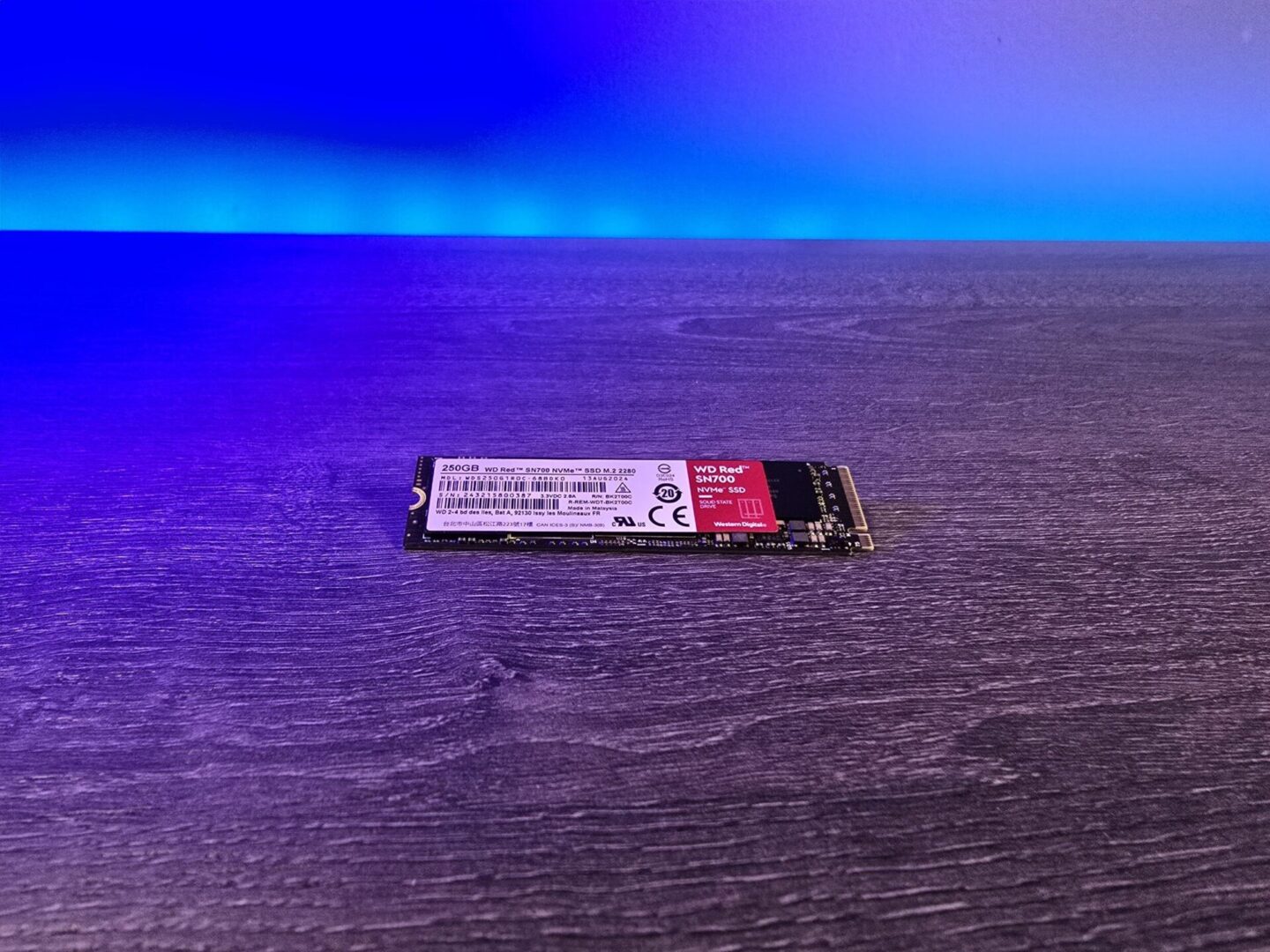
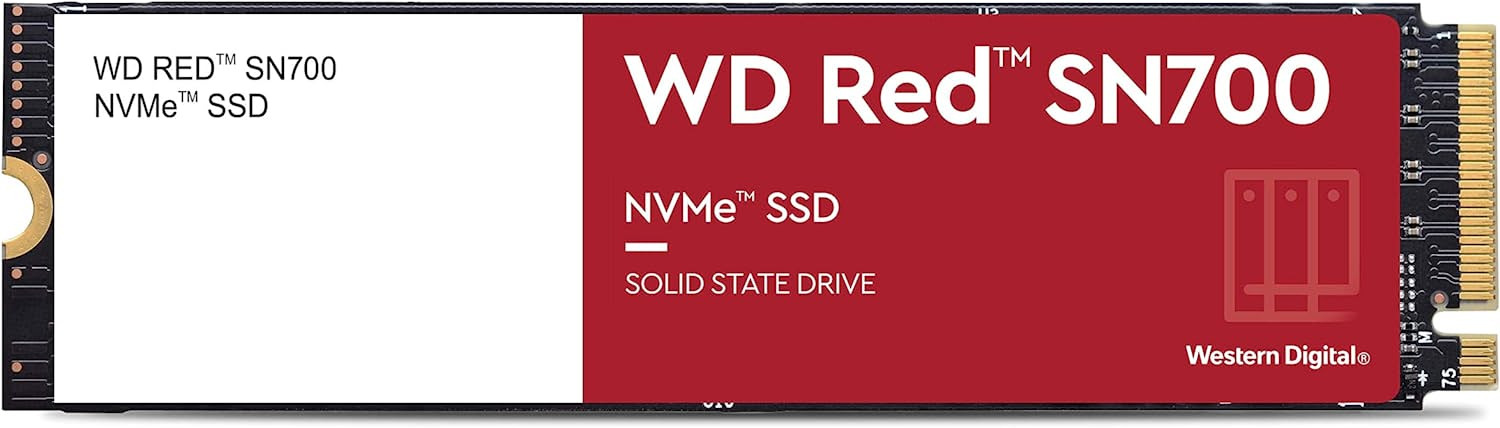
WD Red SN700 NVMe SSD: Best Small Cache Drive
250GB · 500GB · 1TB · 2TB · 4TB · 5-year warranty
Of the two, this is the one I’ve actually had my hands on. Western Digital provided the eight 250GB drives for the F8 SSD Plus test above, and I used five 250GB WD Red NVMe SSDs in a TrueNAS Community Edition test build in 2025. It’s the previous generation now, but it’s the only one of the two that comes in 250GB (500 TBW) and 500GB (1,000 TBW). That makes it the one to buy for a small cache drive.
Best SSD for NAS Cache
The best SSD for NAS cache is the WD Red SN700 for a small cache drive (250GB or 500GB) and the Sandisk NAS 800 at 960GB and up (a 2025 or later Synology is the exception, covered below). Sandisk’s own guidance is a cache between 2.5% and 10% of the size of the hard drive pool.
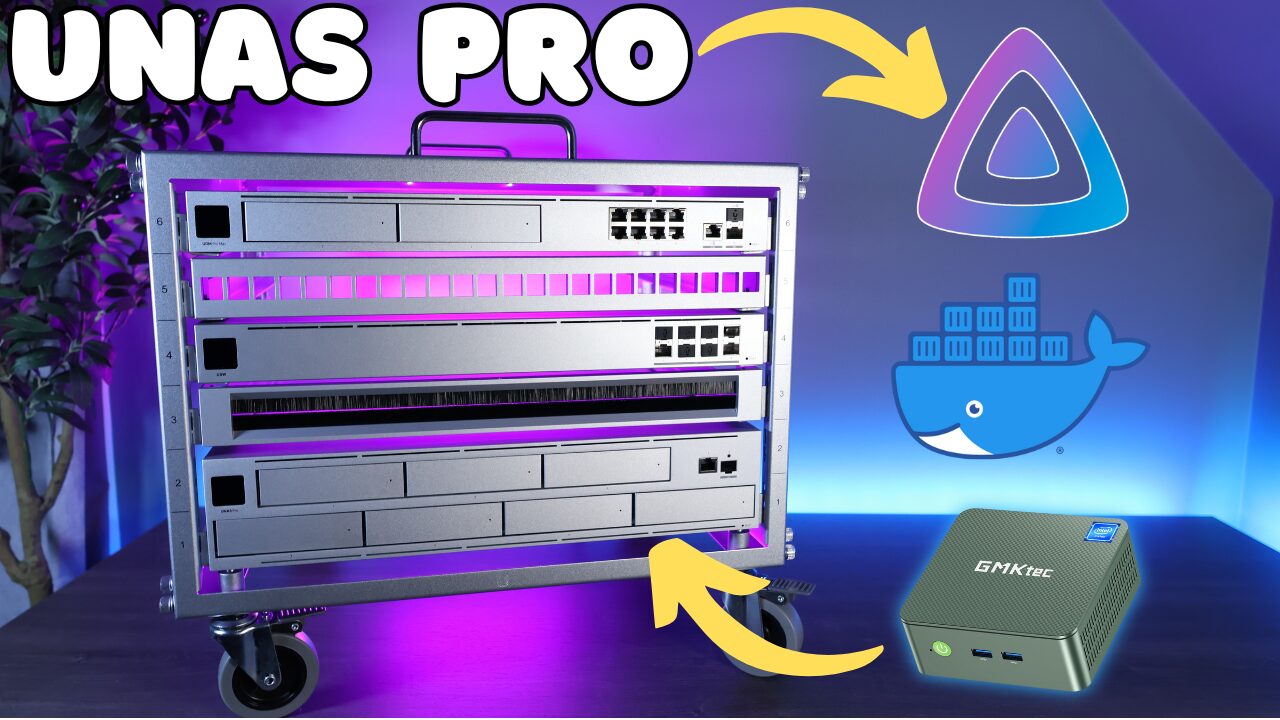
SSD cache is not a miracle that works in all situations. Synology’s own documentation says it won’t improve performance for sequential access, like transferring large files or streaming video. When I tested a UniFi UNAS Pro 8 with read-write cache against a UNAS Pro without it in 2025, the UNAS Pro 8 shined in small workloads, but the UNAS Pro caught up to it in sustained workloads.
Read-write cache should have at least two SSDs and carries a real risk. It holds writes that haven’t reached the hard drives yet, so losing the cache or the power in the middle of a write can corrupt your storage pool. I’ve had clients reach out to me where the cache somehow got unmounted from the storage pool, and they had to go to Synology to get it remounted. None of the Sandisk or WD Red drives here claim power loss protection, so if you’re using read-write cache, put the NAS on a UPS.
The other downside is that you can’t really control what is and isn’t in cache, so for Docker and VMs, I’d rather create a volume on the SSDs. In my 2024 Synology test, the NVMe volume was two Synology SNV3410-400G drives in RAID 1, and transferring a 1GB file between two containers averaged 622 MB/s on it against 157 MB/s on my two-drive hard drive array. A volume gives you that every time, where cache only helps if the data happens to be in it. If you’d still like to use it, here’s how to configure SSD cache on a Synology NAS.
Best SSD for Synology NAS
The best SSD for Synology NAS devices is the Sandisk NAS 600 in a 2.5-inch bay on most models and the Synology SNV5420 for an M.2 storage pool. I’ve been running Synology hardware for close to 10 years, and the drive compatibility policy is the part to check before you buy. This is where it stands as of October 2026 (DSM 7.3 and above):
- 2.5-inch SATA SSDs in DS Plus, Value, and J series models (and desktop FS models like the FS200T): Any SATA SSD can be used, whether it’s on the list or not.
- M.2 NVMe slots on 2025 and later models (DS925+, DS1525+, etc): Only drives on Synology’s compatibility list can be used to create a storage pool or cache. The DS925+ list only has Synology drives on it, so the NAS 800 and SN700 are both out.
- XS+, XS, SA, HD, and rackmount FS series models: Every drive in a new storage pool or cache has to be on the compatibility list, SATA SSDs included.
- Models released before 2025: The policy does not apply to them, but Synology still only supports its own M.2 SSDs for a storage pool.
The other reason to buy Synology’s SSDs is Storage Efficiency (deduplication on an all-SSD volume, on supported models), as the feature is locked behind Synology drives. If you haven’t bought the NAS yet, check out my guides on which Synology NAS to buy and the best hard drives for a Synology NAS.
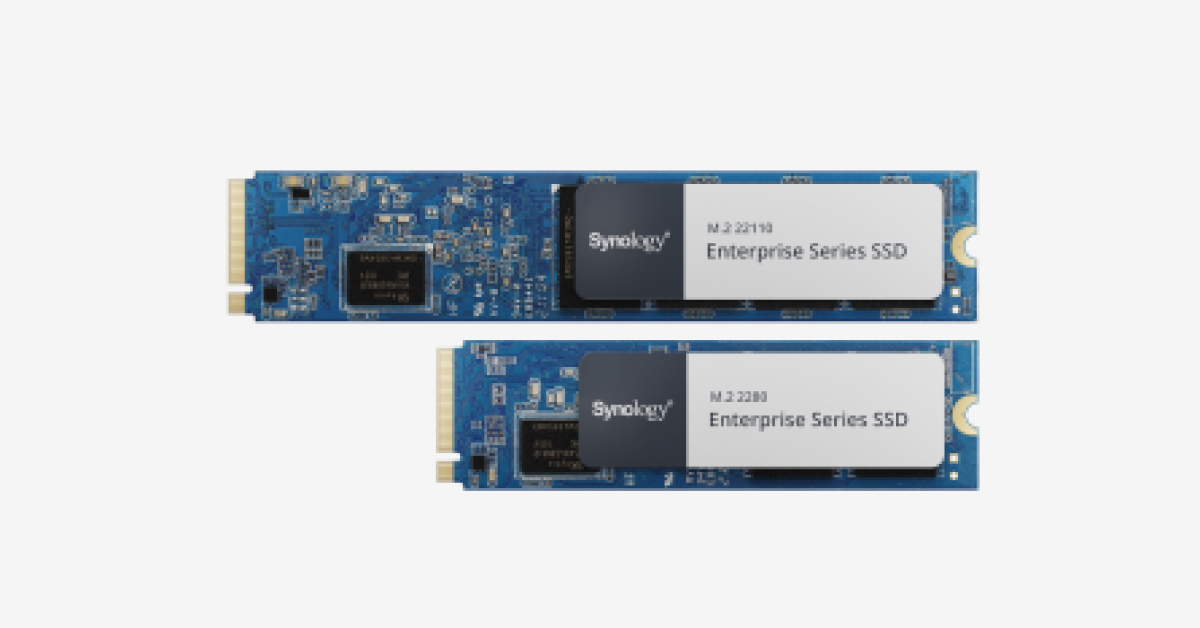
Synology SNV5420: Best M.2 SSD for a Synology NAS
400GB · 800GB · 1.6TB
For an M.2 storage pool on a Synology, or M.2 cache on a 2025 or later model, this is the drive I’d buy from Synology’s list. It’s rated at over 700 TBW at 400GB and has power loss protection, which is what I’d want for read-write cache. The SNV3410-400G (491 TBW) is also on the list, and it’s the drive I used for the NVMe volume test above. The SNV5420 costs a lot more per gigabyte than the drives above, so I would only buy it for one of those two cases.

Synology SAT5221 SATA SSD: For Models That Require Listed Drives
480GB · 960GB · 1.92TB · 3.84TB · 7TB (SAT5210) · 5-year warranty
You might know this as the SAT5200, which is still the series name, but the models Synology lists today are the SAT5221 and the 7TB SAT5210. It’s an enterprise SSD with over 1,700 TBW at 960GB and power loss protection, which is overkill for most home users. Buy it if your Synology model requires it, or if you’d like to use Storage Efficiency on a model that supports it.
What I Would Avoid
- Don’t ignore endurance. When you compare two drives, compare the TBW at the same capacity.
- Don’t use random desktop SSDs for read-write cache. Cache can create heavy writes.
- Don’t buy an M.2 drive for a Synology NAS before checking the compatibility list for your model.